Nine Kangaroo Island animals to look for, and where
Kangaroo Island has been cut off from the mainland for roughly 10,000 years, and some of its animals have drifted apart from their mainland cousins. A day tour can show you a good share of them. These are the nine we would look for, with the places tours tend to find each one.
How to read this list
Some of these animals live in fixed places, so a tour that stops there gives you a strong chance. Others wander, and a sighting depends on luck, the hour and a sharp-eyed guide. We say which is which, but no operator can promise any animal.
The island is roughly 150 km (95 miles) long, and its wildlife is spread across all of it. A day tour from Kingscote or Penneshaw covers the south coast and the west end, which is where most of these nine turn up.
On the coast
1. Australian sea lion
The Australian sea lion is an endangered species, and Seal Bay holds one of its larger colonies. The animals rest on the sand after days of hunting at sea, so a guided beach walk tends to find them dozing near the path.
All three of our land-based day tours include Seal Bay. Our Seal Bay guide explains the beach walk and the distance the rangers ask you to keep.
2. Long-nosed fur seal
On the rocks below Admirals Arch, long-nosed fur seals lie in the sun and slide into the surge. They are a separate species from the sea lions at Seal Bay, with a pointed snout and a thick coat of fur.
You watch them from a boardwalk on the cliff rather than from the shore, so they stay at a distance. Binoculars or a zoom lens help, and the Flinders Chase guide describes the walk down.
3. Bottlenose dolphin
Bottlenose dolphins feed in the waters off Penneshaw and through Backstairs Passage. The coastal safari from ~$62 leaves Christmas Cove Marina to look for them, and people sometimes spot a pod from the ferry deck as well.
Dolphins are wild and come and go, so treat any sighting as a bonus. The same operator sells a swim trip too, and our cruise or swim guide compares the two.
In the bush and paddocks
4. Kangaroo Island kangaroo
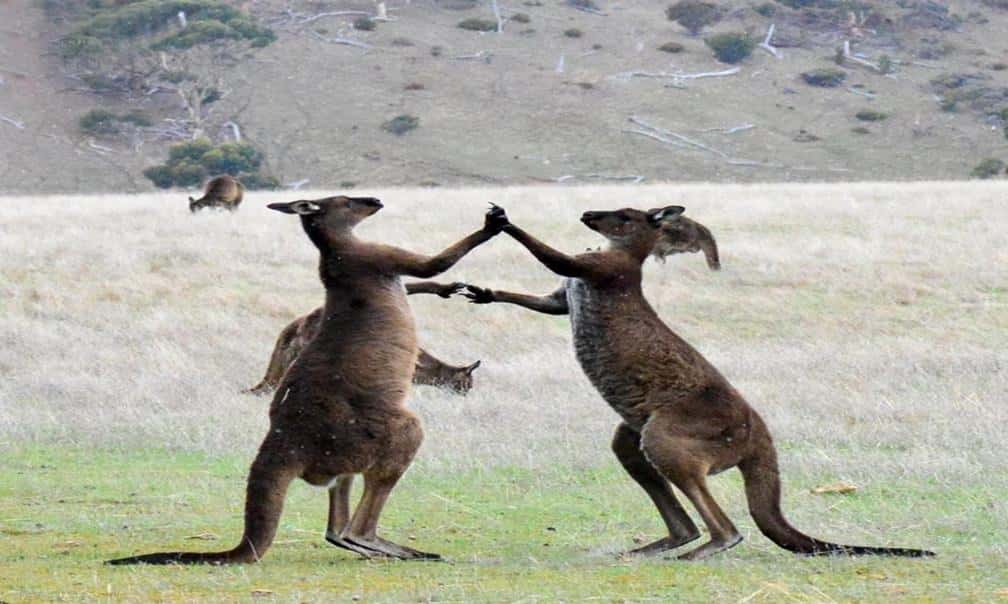
The Kangaroo Island kangaroo is a darker subspecies of the western grey kangaroo, found only here. It is the animal most visitors meet first, grazing in paddocks and along roadsides early and late in the day.
Your chances on a full-day tour are good, more so toward evening. Around midday they tend to rest in the shade, which is where a guide who knows the quiet spots makes a difference.
5. Tammar wallaby
The tammar wallaby is much smaller than a kangaroo and easy to mistake for a young one. It became rare on the South Australian mainland, while the island kept a healthy population.
Tammars mostly come out at dusk and after dark, so daytime tours see fewer of them. The Hanson Bay koala walk names them among the animals you may meet in its sanctuary.
6. Koala
Koalas are not native to the island. They were brought over in the 1920s and multiplied in the manna gums, and the Black Summer bushfires of 2019–20 later killed many of them, mostly in the west.
The Hanson Bay koala walk from ~$32 takes you into sanctuary areas the public cannot enter alone. Day tours often stop at roadside gums too, though their listings do not promise koalas; see where the koalas are.
Sea lions and fur seals in one long day
SeaLink's day trip takes the coach and ferry from Adelaide, walks the beach at Seal Bay with a guide and stops at both Flinders Chase sights, with a 2-course lunch on the way. It is a 16-hour day in a big coach group.
7. Short-beaked echidna
The short-beaked echidna is a spiny, egg-laying mammal, and the island has its own subspecies. Echidnas trundle along roadsides and through scrub hunting for ants, at almost any hour.
Sightings come down to luck. If you meet one, stand still and stay quiet, since a startled echidna digs in and curls up, and it moves on sooner when left alone.
Rarer finds
8. Glossy black-cockatoo
The island's glossy black-cockatoo is a rare, endangered subspecies that feeds almost only on she-oak cones. Listen for cones cracking overhead, then look for dark birds with a flash of red or orange in the tail.
Do not expect one on a standard tour. They feed in scattered patches of she-oak woodland, and a guide may point one out only if the group passes the right trees at the right moment.
9. Rosenberg's goanna
Rosenberg's goanna, also called the heath goanna, is a large monitor lizard, and the island is thought to be one of its strongholds. On warm days it basks on roads and tracks, so watch for a long, banded shape strolling off into the scrub.
Summer and early autumn are your likeliest months, since goannas stay out of sight in cold weather. Seeing one is a pleasant surprise rather than something to plan around.
The Kangaroo Island dunnart, a mouse-sized marsupial found only here, is another matter. It is critically endangered and active at night, so almost no visitor ever sees one.
Dusk, roads and your own car
Kangaroos and wallabies come out to feed at dusk and stay busy through the night. That is also when most roadkill happens on the island, and a collision can wreck both a hire car and the animal.
If you drive yourself, aim to reach your bed before dark, or drive slowly with full attention. Tours with a local driver take that worry away, which is one reason we like them for the long run west.
Matching animals to a tour
For sea lions and fur seals on the same day, any tour that visits both Seal Bay and Flinders Chase will do. Our guide to the best months covers when spring joeys and winter whales join the list.
For koalas, add the Hanson Bay walk on a separate morning or afternoon. For dolphins, add the boat safari from Penneshaw on your arrival or departure day. Both are short, which leaves the long tour free for the land animals.